Solar-powered pleasure boat achieves 39.8% excess energy margin
Researchers have designed a 10.56 kW solar-battery system for a pleasure boat that meets six hours of daily propulsion demand with a 39.8% energy surplus, demonstrating viability for marine applications.
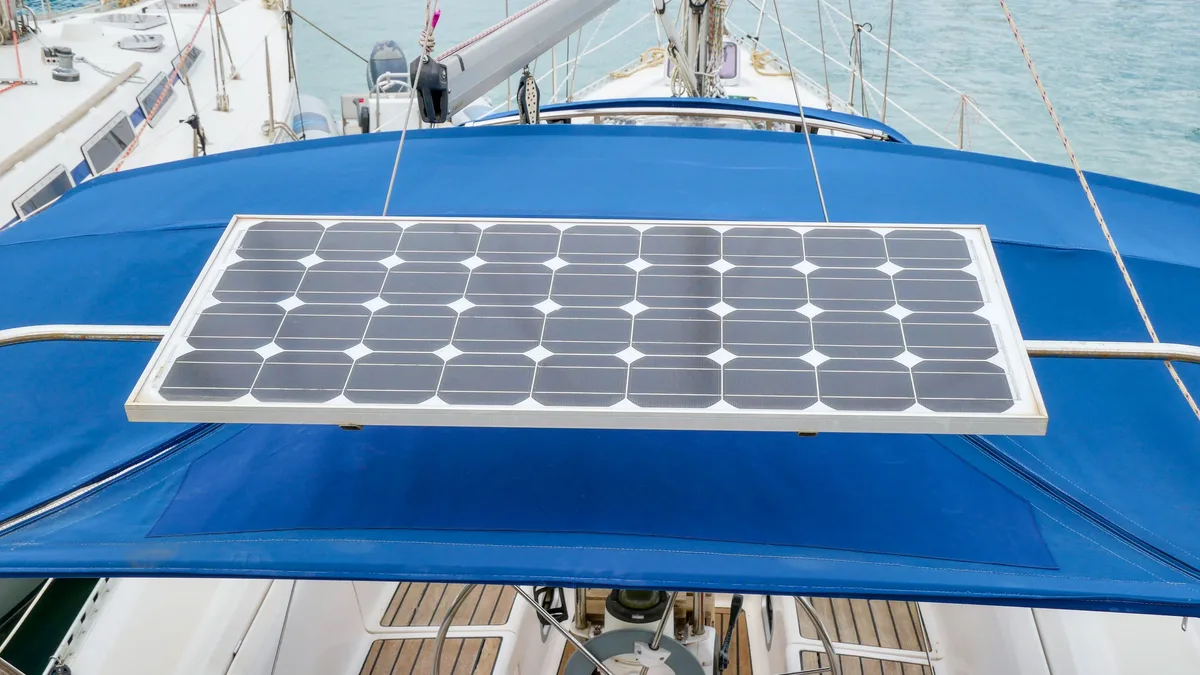
A Canadian research team has engineered a fully integrated solar-powered pleasure boat system that meets propulsion demands with a significant energy surplus. The system, designed by researchers from Memorial University of Newfoundland, features a 10.56 kW solar array and a 19.68 kWh battery bank to power a boat for six hours daily with a 39.8% energy margin.
The boat is 11.8 meters long and 5.8 meters wide, with a full-load displacement of about 2,250 kg. It can carry five to six adults. The integrated system uses 32 solar modules rated at 330 W each, covering an area of 62.4 square meters. Energy is stored in a 48 V, 410 Ah battery bank composed of eight lead-acid batteries. Two 2.5 kW brushless DC motors propel the vessel to a target speed of 5.4 knots.
| Component | Specification |
|---|---|
| Solar Modules | 32 x 330 W |
| Total Solar Capacity | 10.56 kW |
| Panel Area | 62.4 m² |
| Battery Bank | 48 V, 410 Ah |
| Nominal Storage | 19.68 kWh |
| Number of Batteries | 8 (lead-acid) |
| Motors | 2 x 2.5 kW brushless DC |
| Target Speed | 5.4 knots |
| Passenger Capacity | 5-6 adults |
Energy performance and efficiency
The system was designed to meet an estimated daily energy demand of 30 kWh for six hours of operation. Based on local solar resource data showing average daily irradiation of 5.43 kWh/m², the array fully satisfies the baseline propulsion demand. It achieves a 39.8% excess energy margin.
Four incremental-conductance maximum power point tracking controllers were used to optimize solar output and reduce power-tracking oscillations. The solar modules are organized into four independently controlled subarrays. Dynamic simulation results confirm the system can attain a maximum output of nearly 10.98 kW under localized clear-sky irradiance peaks. The battery bank alone can supply two hours of backup power.
Future development paths for the project include techno-economic sensitivity analyses. These will assess the levelized cost of energy, net present cost, capital paybacks, and cycle degradation under fluctuating market interest rates and fuel prices.
Control and stability systems
Motor speed is maintained at 2,000 rpm using Hall-effect sensors and closed-loop proportional-integral-derivative control. A central energy management system caps the battery charging current at approximately 50 A.
This same system held DC-bus voltage fluctuations within plus or minus 3% of the nominal 48 V rating during simulations. The setup uses a boost converter with the incremental-conductance maximum power point tracking algorithm for stability.
Validation and future research
The study, titled 'Integrated modeling and performance assessment of a stand-alone PV-battery system for a solar-powered pleasure boat,' was published in the journal Next Research. The team used a two-stage evaluation method with HOMER Pro and MATLAB/Simulink software. Simulations examined solar-only, combined PV-battery, and battery-only operating modes.
The researchers highlighted the environmental benefits of such a system. It eliminates localized greenhouse gas emissions, cuts acoustic pollution, and averts possible fuel-spill contamination in sensitive marine ecosystems.
They also noted that experimental validation via physical full-scale sea trials is necessary to verify real-world hydrodynamic drag effects. The research team will conduct these trials to confirm the simulation assumptions.